Research Article | | Peer-Reviewed

Overactive Bladder Syndrome in Young Adults: Prevalence and Impacts on Quality of Life

Received: 24 March 2026     Accepted: 16 April 2026     Published: 13 May 2026
Views:       Downloads:
Abstract

Introduction: Overactive bladder syndrome is a clinical condition that affects both males and females and has a significant negative impact on the quality of life. Overactive bladder syndrome refers to a chronic condition of the urinary bladder characterized by a constellation of predominantly storage lower urinary tract symptoms. Overactive bladder syndrome is a clinical diagnosis that suggests significant bladder dysfunction, failure of urine storage and often associated with detrusor over activity during the bladder filling phase. The etiology and pathophysiology remains largely unknown with studies suggesting possible multifactorial causes. Despite the appreciable burden on young adults, several studies underestimated prevalence of overactive bladder syndrome amongst young adults. Overactive Bladder Symptom Score is a reliable and valid tool in symptom assessment and re-evaluation following treatment. This study is focus in finding the prevalence of overactive bladder syndrome in young adults as well as the impact on QoL. Methodology: This is a prospective randomized cross-sectional study. By simple random sampling, consenting participants who met the inclusion criteria were recruited for the study. A structured questionnaire (overactive bladder syndrome score- OABSS) was utilized in assessment of symptom severity and impact. The Completed questionnaire/proforma of all the recruited subjects were collated and analyzed using Statistical Package for the Social Sciences (SPSS) version 23.0 and P values less than 0.05 were considered to be statistically significant. Results: A total of 306 individuals participated in the study. One hundred and eighty (58.8%) participants were females while 126 (41.2%) were males. The age range of the participants was 20 – 40 years with a mean age of 29.8 +/- 5.6. The overall OABSS ranges from 0 – 15 with a mean score of 2.09+/-2.05. Two hundred and sixty four participants (93.14%) had OABSS of 0 – 5 which represents mild or no symptoms, 5.88% had moderate symptoms while 0.98% had severe symptoms. Females report significantly higher OABSS than males. The mean score of OABS in females was 2.52 while the mean score of OABS in males was 1.48. Conclusion: Overactive Bladder Syndrome refers to a chronic embarrassing condition of the urinary bladder. Despite the appreciable burden on young adults, it is more prevalent in females. It remains an evolving pathology which becomes more manifest with aging and often underreported amongst younger individual for obvious reasons. Though management could be challenging, exiting prospects via awareness and innovations can never be overemphasized.

Published in Central African Journal of Public Health (Volume 12, Issue 3)
DOI 10.11648/j.cajph.20261203.12
Page(s) 141-147
Creative Commons

This is an Open Access article, distributed under the terms of the Creative Commons Attribution 4.0 International License (http://creativecommons.org/licenses/by/4.0/), which permits unrestricted use, distribution and reproduction in any medium or format, provided the original work is properly cited.

Copyright

Copyright © The Author(s), 2026. Published by Science Publishing Group

Keywords

Overactive Bladder, Overactive Bladder Symptom Score, Lower Urinary Tract Symptoms, Quality of Life

1. Introduction
Overactive bladder syndrome (OABS) is a clinical condition that affects both males and females and has a significant negative impact on the quality of life (QoL). Overactive bladder syndrome (OABS) refers to a chronic condition of the urinary bladder characterized by a constellation of predominantly storage lower urinary tract symptoms (LUTS). OABS as a terminology was first used in 1988 by the International Continence Society (ICS) Committee on Standardization of Terminology to describe their observation of detrusor muscle hyperactivity with urodynamic studies in patients with storage lower urinary tract symptoms. The International Continence Society (ICS) defined overactive bladder as the presence of urinary urgency which is a sudden and compelling desire to void that is difficult to defer and often accompanied by frequency and nocturia with or without urge incontinence in the absence of a proven infection or other obvious pathology. OABS is a clinical diagnosis that suggests significant bladder dysfunction, failure of urine storage and often associated with detrusor over activity during the bladder filling phase. The etiology and pathophysiology remains largely unknown with several studies suggesting possible multifactorial causes.
The epidemiological profile of OABS has historically been associated with older populations negating the fact that it can occur in young adults. Large-scale multinational studies reported that although OABS is seen more in older population, the clinical manifestation starts in early adulthood and exponentially progresses. In a multinational study involving six European countries, the overall prevalence of OABS amongst 16,776 subjects aged 40 and above was high with frequency accounting for 85% and remains the commonest symptom followed by urgency (54%) and urge incontinence (36%). OABS is highly prevalent in the general population impacting on QoL of the affected individuals with only a few receiving proper medical attention.
Over 33million individuals in the United States of American has OABS and this tends to have an exponential relationship with age and sex. The association of OABS with symptomatic benign prostatic enlargement also contributes to the erroneous impression that it only occurs in older men hence the reason for the perception of OABS as a geriatric condition. Despite the high prevalence of OABS, patients often shy away from discussing this issue with health service providers for fear of stigmatization which invariably contributes to the underreported prevalence globally. These symptoms has a significant impact on social relationship with consequent altered sleep pattern/disorder, depression, anxiety disorder, withdrawal from social and sexual activities. In extreme cases, the alteration is sleep pattern can result to a more serious consequences such as fall-related injuries/fractures. The economic burden of OABS remains significant especially in developing countries. The lack of insurance coverage coupled with high poverty rate deters individuals suffering from this conditions from seeking medical intervention.
Urgency is the keystone of OABS and together with urge incontinence and nocturia are seen as the most frustrating symptoms. This has significant unintended consequences for younger patients with OAB who are likely to be misdiagnosed. The constant bathroom mapping associated with OABS affects the quality of life and relationship of these young individual. Younger patients with mild symptoms often believe these typical symptoms are normal for their age. Those with severe symptoms feel embarrassed to discuss these challenges hence adopting a silent survival strategies with consequent delay in diagnosis and intervention. This may account for the cycle of underreporting and misrepresentation amongst these age group in clinical practice. The impact of overactive bladder on quality of life (QoL) is well-documented in older age group but ignored for young adults. Factors that affect the misrepresentation of overactive bladder in younger adults are guided by educational qualification, career path and socioeconomic status. The symptoms of overactive bladder invariably threatens core activities of these young adults coupled with possible stigmatization that they may suffer while seeking intervention. Temml C et al reported that affected young adult presents with significant anxiety disorder, depression, reduced self-esteem, stigmatization, reduced productivity and absenteeism. The effect of frequenting the restroom coupled with planning daily life around toilet access seen in these group of patients is referred to as "toileting mapping". This could leads to social withdrawal tendencies, isolation as well as avoidance of physical processes and romantic encounter.
The pathophysiology of overactive bladder syndrome in younger adults may differ from older individuals. Risk factors in older individuals includes age-related detrusor degeneration and comorbidities such as hypertension and diabetes mellitus. Potential factors that may cause overactive bladder syndrome in young individuals are:
1) Idiopathic detrusor over-activity.
2) Childhood nocturnal enuresis and OABS in adulthood may have a strong link.
3) Pelvic floor dysfunction especially in young women.
4) Neurological damage or chronic inflammatory diseases affecting the pelvic organs.
5) Familial and genetic predisposition.
6) High levels of stress, anxiety and certain behavioral patterns can mimic or worsen overactive bladder syndrome.
Overactive bladder syndrome affects the mental, occupational and sexual aspects of those suffering from it including young adults posing a significant threat to their daily activities. Despite these appreciable burden on young adults, several studies reported underestimated prevalence of OABS amongst young adults aged 18-35. OABS affects both sexes and seems to be more prevalent in females. Coyne KS et al reported a prevalence of 36% in males and 43% in females older than 40 years. Prevalence data are peculiar and may vary across several cultures with lack of precise age-stratified data and appreciable negative impact on the quality of life and economic burden. These may hinder the development of targeted public health awareness campaigns with uninformed health care providers who are likely to misdiagnose this condition.
Overactive bladder symptom score (OABSS) is a valid structured questionnaire and serves as a tool to objectively assess the severity and impact of the disease on QoL. It is seen as a comprehensive self-administered tool designed to enable patients evaluate their symptoms and the impact on daily activities. Overactive bladder symptom score (OABSS) is also reliable and valid in symptom re-evaluation following treatment. The score ranges from 5 to 15, where a score of 5 or less indicates mild symptoms, 6 to 11 indicates moderate symptoms while 12 to 15 indicates severe symptoms.
Re-evaluating treatment outcome after an acceptable treatment interval is an effective way to assess the efficacy of a particular drug regimen on OABS. The OABSS questionnaire is designed to quantify OABS and contains questions that address four symptoms of overactive bladder including frequency, nocturia, urgency and urge incontinence.
Overactive bladder syndrome has been erroneously seen as a geriatric condition and rarely considered in younger adult. The paucity of data on the disease burden amongst younger population is worth exploring. Several authors focused on older population and negating the impact of this disease in young adults including the vicious cycle of depression and isolation. This study is focused primarily in finding the prevalence of OABS in young adults as well as the likely impact on QoL and performance.
2. Methodology
This is a prospective randomized cross-sectional study carried out in Federal Medical Center Abuja, Nigeria over a period of one year. By simple random sampling, participants were recruited for the study. The participants were recruited from consenting patients and relatives that presented to the facility for other reasons. During these period all consenting participants who met the inclusion criteria were recruited for the study.
Inclusion criteria:
1) All consenting subjects.
2) Adults between the ages of 18 - 40.
Exclusion criteria:
1) Subjects who has had prostate surgery.
2) Subjects who has had urethral surgery.
3) Subjects with predominantly voiding lower urinary tract symptoms (LUTS).
4) Subjects who has hypertension and diabetes mellitus.
5) Subjects on urethral catheter.
Two questionnaires were administered to consenting participants. The first is a structured and valid questionnaire (overactive bladder syndrome score- OABSS) to objectively assess the presence of OABS and the symptoms severity. The second is a proforma designed to obtain the relevant information including biodata, risk factors and confirm absence of comorbid conditions including chronic hypertension and long standing diabetes mellitus. The 2 questionnaires (proforma and OABSS) were administered to only those that met the inclusion criteria above and those with hypertension and diabetes mellitus were excluded abinitio. Those who could not read English language were assigned an interpreter.
Completed questionnaire/proforma of all the recruited subjects were collated and analyzed using statistical package for the social sciences (SPSS) version 23.0 and P values less than 0.05 were considered to be statistically significant. Welch’s T test, box plot and scatter plot were used to compare means where appropriate. The result is represented in the form of tables and charts.
3. Results
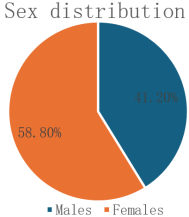
A total of 306 individuals participated in the study voluntarily. One hundred and eighty participants were females while 126 were males as depicted in Figure 1.
Figure 1. Sex distribution of participants.
The age range of the participants was 20 – 40 years with a mean age of 29.8 +/- 5.6. The overall OABSS ranges from 0 – 15 with a mean score of 2.09+/-2.05. Two hundred and sixty four participants (93.14%) had OABSS of 0 – 5 which represents mild or no symptoms, 5.88% had moderate symptoms while 0.98% had severe symptoms. The total number of participants who has OABS (moderate and severe symptoms) was 6.86%. The precise overall score frequency table is shown in Table 1.
Table 1. Detailed frequency distribution of OABSS showing specific number of participants and their OABSS.

OABSS

Frequency/number of participant

0

42

1

93

2

84

3

51

4

15

6

9

7

6

8

3

15

3

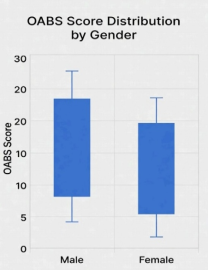
Females report significantly higher OABSS than males. The mean score of OABS in females was 2.52 +/- 1.75 while the mean score of OABS in males was 1.48 +/- 1.0 as shown in Table 2 and Figure 2. The statistical test (Welch’s t-test) shows p value of 0.0055 which depicts significant difference.
Table 2. Gender distribution of OABSS.

Gender

Mean score

Female

2.52 +/- 1.75

Male

1.48 +/- 1.06

Figure 2. Gender distribution of OABSS.
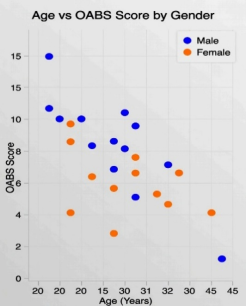
There was no correlation or relationship between age and OABSS and the p value was -0.003 as shown in Figure 3 below.
Figure 3. Showing age and OABSS by gender.
There was also no identifiable risk factor as all the participants with OABS could not identify the likely cause of the disease.
Key findings and outliers were noted. Three notable outlier was in a 24, 26 and 28 year old females with OABSS of 15 which was the highest in the entire dataset. The highest male overactive bladder symptoms score was 6. Symptoms due to overactive bladder appears unrelated to age. Two hundred and eighty five participants out of 306 participants (93.13%) had mild OABSS of between 0 -3.
We also observed that OABS are generally mild in this young adult population with female participants reporting significantly high symptoms score compared to males participants.
4. Discussion
Overactive Bladder Syndrome (OABS) refers to a chronic embarrassing condition of the urinary bladder affecting both males and females and characterized by a constellation of predominantly storage lower urinary tract symptoms (LUTS) with negative impact on quality of life (QoL). OABS is a clinical diagnosis that occurs due to failure of urine storage often associated with detrusor over-activity during the bladder filling phase. The etiology and pathophysiology remains largely unknown with studies suggesting possible multifactorial causes and associating the condition to older population.
Over the years, OABS has been linked solely to the older populations negating the fact that it can occur in any age group. Large-scale multinational studies reported that although OABS is seen more in older population, the clinical manifestation starts in early adulthood and the severity exponentially worsens with aging. This index study showed that OABS though not common amongst younger population, remains an evolving pathology with the sufferers likely to present for treatment at an advance age when the severity becomes unbearable. Several studies emphasized that OABS affects all age groups but seen more in patients aged 40 and above. Our findings showed that only 6.86% of the participants had both moderate and severe symptoms and felt unhappy with their QoL. This is in keeping with the observation of Irwin et al and furthers supports the revelation that OABS is rare in the younger population. While many studies reported that OABS is rare amongst young adults, we believe that the symptoms probably started much earlier which exponential severity.
Milsom et al reported that the overall prevalence of OABS amongst 16,776 subjects aged 40 and above was high with frequency accounting for 85% and remains the commonest symptom followed by urgency (54%) and urge incontinence (36%). This is at variance with our findings which showed severe symptoms amongst females less than 28 years. However, this strongly supports the fact the OABS can affect any age group and should be considered while evaluating all patients with predominantly storage LUTS. Obiatuegwu et al reported that the association of OABS with symptomatic benign prostatic enlargement (BPE) may contribute to the erroneous impression that it only occurs in older men hence the reason for the perception of OABS as a geriatric condition. This index study assessed only the younger population who do not have benign prostatic enlargement and observed higher prevalence in females with an overall prevalence of 6.86%. This is also at variance with the observation of Obiatuegwu et al as females who do not have prostate had severe symptoms compared to males. Stewart et al reported that over 33 million individuals in the USA has OABS and this tends to have an exponential correlation with age and sex. This is at variance with our finding which reported no correlation or relationship between age and OABSS with a p value was -0.003. The variation in our observation may be related to the study population as we dwelt on prevalence amongst adults less than 40 years.
Urgency, urge incontinence and nocturia are seen as the most frustrating symptoms which may have significant consequences for younger patients with OABS with major impact on quality of life (QoL) and sexual performance. Our study noted severe symptoms in female participants less than 28 years who are probably at the peak of their sexual life. This will definitely impact negatively in their QoL and sexual performance. Younger patients also often feel embarrassed to discuss these challenges which probably leads to delay in presentation, diagnosis and intervention. This probably accounted for the low prevalence observed in our study. The effect of OABS on quality of life (QoL) is well-documented in older age group, but often ignored in young adults who may suffer more social consequences. Temml C et al observed that young adults may present with significant depression, stigmatization and reduced productivity with toilet mapping leading to social isolation which affects QoL. This may be the reason for the denial of symptoms which probably led to low prevalence in our study.
The pathogenesis of OABS in younger adults may differ from older individuals. The etiology in older patients includes age-related detrusor dysfunction, hypertension and diabetes mellitus. Younger patients are less likely to have these confounding factors that are likely impact on the prevalence of OABS. The exclusion of comorbid conditions probably contributed to the low prevalence of OABS observed in this index study. Potential causes of overactive bladder syndrome in young adults are uncommon and includes idiopathic detrusor over-activity, childhood nocturnal enuresis, neurological damage, chronic inflammatory diseases affecting the pelvic organs as well as familial/genetic predisposition. The fact that these risk factors are rare also contributed to the low prevalence of OABS in this index study. Despite the appreciable burden on young adults, OABS affects both sexes and seems to be more prevalent in females. This is similar to our finding that observed high prevalence in females. Severe symptoms was also noted only amongst female participants. Coyne et al reported a prevalence of 36% in males and 43% in females older than 40 years. This is at variance with our findings that reported a low prevalence of 6.86% probably due to the fact that we focused only on participants younger than 40 years. However, a common finding with several studies remains that OABS is commoner amongst females compared to males.
Overactive Bladder Symptom Score (OABSS) is a reliable structured questionnaire and serves as a tool to objectively assess the severity of symptoms and also valid in symptom re-evaluation following treatment. This study focused on the prevalence of OABS and OABSS served as a convenient tool in evaluating the presence of OABS in these participants. This supports the observation of Homma et al. Prevalence data may vary depending on the study population with appreciable negative impact on the quality of life. We noted that the outliers exhibited certain degree of frustration in their inability to finding a lasting solution to their symptoms which had significant impacted on their relationship with severe emotional distress.
Overactive bladder syndrome remains an evolving pathology which becomes more manifest with aging and is often underreported amongst younger individual for obvious reasons. Though the prevalence is low amongst young adults, the impact is significant and should be considered in the evaluation of young adults with predominantly storage LUTS. The management can be challenging due to late presentation coupled with the fear of stigmatization. The role of awareness, psychological support and innovations can never be overemphasized.
Abbreviation

OABS

Overactive Bladder Syndrome

OABSS

Overactive Bladder Symptom Score

QoL

Quality of Life

LUTS

Lower Urinary Tract Symptoms

ICS

International Continence Society

BPE

Benign Prostatic Enlargement

SPSS

Statistical Package for Social Sciences

Author Contributions
Obiatuegwu Kenenna Onyeka: Conceptualization, Formal Analysis, Investigation, Methodology, Project administration, Supervision, Validation, Visualization, Fund acquisition, Writing–review & editing
Funding
This article was funded by the author.
Data Availability Statement
All data are available in archive.
Conflicts of Interest
The author declares no known competing financial interests or personal relationships that could have appeared to influence the work reported in this paper.
References
[1] Leron E, Weintraub AY, Mastrolia SA, Schwarzman P. Overactive bladder syndrome: Evaluation and management. Curr Urol. 2018; 11: 117–125.
[2] Haylen BT, de Ridder D, Freeman RM, Swift SE, Berghmans B, Lee J, Monga A, Petri E, Rizk DE, Sand PK, Schaer GN. An International Urogynecological Association (IUGA)/International Continence Society (ICS) joint report on the terminology for female pelvic floor dysfunction. Int Urogynecol J. 2010 Jan; 21(1): 5-26.
[3] Abrams P, Cardozo L, Fall M, Griffiths D, Rosier P, Ulmsten U, van Kerrebroeck P, Victor A, Wein A. The standardisation of terminology of lower urinary tract function: report from the Standardisation Sub-committee of the International Continence Society. Neurourol Urodyn. 2002; 21(2): 167-78.
[4] Irwin DE, Milsom I, Hunskaar S, Reilly K, Kopp Z, Herschorn S, Coyne K, Kelleher C, Hampel C, Artibani W, Abrams P. Population-based survey of urinary incontinence, overactive bladder, and other lower urinary tract symptoms in five countries: results of the EPIC study. Eur Urol. 2006 Dec; 50(6): 1306-14; discussion 1314-5.
[5] Milsom I, Abrams P, Cardozo L, Roberts RG, Thüroff J, Wein AJ. How widespread are the symptoms of an overactive bladder and how are they managed? A population-based prevalence study. BJU Int. 2001 Jun; 87(9): 760-6.
[6] Stewart WF, Van Rooyen JB, Cundiff GW, Abrams P, Herzog AR, Corey R, Hunt TL, Wein AJ. Prevalence and burden of overactive bladder in the United States. World J Urol. 2003 May; 20(6): 327-36.
[7] Temml C, Heidler S, Ponholzer A, Madersbacher S. Prevalence of the overactive bladder syndrome by applying the International Continence Society definition. Eur Urol. 2005 Oct; 48(4): 622-7.
[8] Shaw C, Tansey R, Jackson C, Hyde C, Allan R. Barriers to help seeking in people with urinary symptoms. Fam Pract. 2001 Feb; 18(1): 48-52.
[9] Teunissen D, Lagro-Janssen T. Urinary incontinence in community dwelling elderly: are there sex differences in help-seeking behaviour? Scand J Prim Health Care. 2004 Dec; 22(4): 209-16.
[10] Coyne KS, Payne C, Bhattacharyya SK, Revicki DA, Thompson C, Corey R, Hunt TL. The impact of urinary urgency and frequency on health-related quality of life in overactive bladder: results from a national community survey. Value Health. 2004 Jul-Aug; 7(4): 455-63.
[11] Irwin DE, Milsom I, Kopp Z, Abrams P, Cardozo L. Impact of overactive bladder symptoms on employment, social interactions and emotional well-being in six European countries. BJU Int. 2006 Jan; 97(1): 96-100.
[12] Wennberg AL, Molander U, Fall M, Edlund C, Peeker R, Milsom I. A longitudinal population-based survey of urinary incontinence, overactive bladder and other lower urinary tract symptoms in women. Eur Urol. 2009 Apr; 55(4): 783-91.
[13] Nicolson P, Kopp Z, Chapple CR, Kelleher C. It's just the worry about not being able to control it! A qualitative study of living with overactive bladder. Br J Health Psychol. 2008 May; 13(Pt 2): 343-59.
[14] Fitzgerald MP, Thom DH, Wassel-Fyr C, Subak L, Brubaker L, Van Den Eeden SK, Brown JS; Reproductive Risks for Incontinence Study at Kaiser Research Group. Childhood urinary symptoms predict adult overactive bladder symptoms. J Urol. 2006 Mar; 175(3 Pt 1): 989-93.
[15] Nuotio M, Jylhä M, Koivisto AM, Tammela TL. Association of risk factors and lower urinary tract symptoms in men and women. BJU Int. 2002 May; 89(7): 661–6.
[16] Abrams P, Kelleher CJ, Kerr LA, Rogers RG. Overactive bladder significantly affects quality of life. Am J Manag Care. 2000 Jul; 6(11 Suppl): S580-90.
[17] Coyne KS, Sexton CC, Kopp ZS, Ebel-Bitoun C, Milsom I, Chapple C. The impact of overactive bladder on mental health, work productivity and health-related quality of life in the UK and Sweden: Results from EpiLUTS. BJU Int. 2011; 108: 1459–1471.
[18] Tikkinen KA, Tammela TL, Rissanen AM, Valpas A, Huhtala H, Auvinen A. Is the prevalence of overactive bladder overestimated? A population-based study in Finland. PLoS One. 2007 Feb 7; 2(2): e195.
[19] Obiatuegwu K, Atim T, Abu S, Aisuodionoe-Shadrach O, Dakum N. Correlation between the severity of erectile dysfunction and prostate size in patients with benign prostatic enlargement. Afr J Urol 27, 31 (2021).
[20] Homma Y, Yoshida M, Seki N, Yokoyama O, Kakizaki H, Gotoh M, Yamanishi T, Yamaguchi O, Takeda M, Nishizawa O. Symptom assessment tool for overactive bladder syndrome--overactive bladder symptom score. Urology. 2006 Aug; 68(2): 318-23.
[21] Obiatuegwu K, Magnus F, Aniede E, Magnus V. Relationship between Erectile Dysfunction and International Prostate Symptom Score. Clinical Medicine Research, 2025, 14(5), 181-186.
Cite This Article
  • APA Style

    Onyeka, O. K. (2026). Overactive Bladder Syndrome in Young Adults: Prevalence and Impacts on Quality of Life. Central African Journal of Public Health, 12(3), 141-147. https://doi.org/10.11648/j.cajph.20261203.12

    Copy | Download

    ACS Style

    Onyeka, O. K. Overactive Bladder Syndrome in Young Adults: Prevalence and Impacts on Quality of Life. Cent. Afr. J. Public Health 2026, 12(3), 141-147. doi: 10.11648/j.cajph.20261203.12

    Copy | Download

    AMA Style

    Onyeka OK. Overactive Bladder Syndrome in Young Adults: Prevalence and Impacts on Quality of Life. Cent Afr J Public Health. 2026;12(3):141-147. doi: 10.11648/j.cajph.20261203.12

    Copy | Download

  • @article{10.11648/j.cajph.20261203.12,
      author = {Obiatuegwu Kenenna Onyeka},
      title = {Overactive Bladder Syndrome in Young Adults: Prevalence and Impacts on Quality of Life},
      journal = {Central African Journal of Public Health},
      volume = {12},
      number = {3},
      pages = {141-147},
      doi = {10.11648/j.cajph.20261203.12},
      url = {https://doi.org/10.11648/j.cajph.20261203.12},
      eprint = {https://article.sciencepublishinggroup.com/pdf/10.11648.j.cajph.20261203.12},
      abstract = {Introduction: Overactive bladder syndrome is a clinical condition that affects both males and females and has a significant negative impact on the quality of life. Overactive bladder syndrome refers to a chronic condition of the urinary bladder characterized by a constellation of predominantly storage lower urinary tract symptoms. Overactive bladder syndrome is a clinical diagnosis that suggests significant bladder dysfunction, failure of urine storage and often associated with detrusor over activity during the bladder filling phase. The etiology and pathophysiology remains largely unknown with studies suggesting possible multifactorial causes. Despite the appreciable burden on young adults, several studies underestimated prevalence of overactive bladder syndrome amongst young adults. Overactive Bladder Symptom Score is a reliable and valid tool in symptom assessment and re-evaluation following treatment. This study is focus in finding the prevalence of overactive bladder syndrome in young adults as well as the impact on QoL. Methodology: This is a prospective randomized cross-sectional study. By simple random sampling, consenting participants who met the inclusion criteria were recruited for the study. A structured questionnaire (overactive bladder syndrome score- OABSS) was utilized in assessment of symptom severity and impact. The Completed questionnaire/proforma of all the recruited subjects were collated and analyzed using Statistical Package for the Social Sciences (SPSS) version 23.0 and P values less than 0.05 were considered to be statistically significant. Results: A total of 306 individuals participated in the study. One hundred and eighty (58.8%) participants were females while 126 (41.2%) were males. The age range of the participants was 20 – 40 years with a mean age of 29.8 +/- 5.6. The overall OABSS ranges from 0 – 15 with a mean score of 2.09+/-2.05. Two hundred and sixty four participants (93.14%) had OABSS of 0 – 5 which represents mild or no symptoms, 5.88% had moderate symptoms while 0.98% had severe symptoms. Females report significantly higher OABSS than males. The mean score of OABS in females was 2.52 while the mean score of OABS in males was 1.48. Conclusion: Overactive Bladder Syndrome refers to a chronic embarrassing condition of the urinary bladder. Despite the appreciable burden on young adults, it is more prevalent in females. It remains an evolving pathology which becomes more manifest with aging and often underreported amongst younger individual for obvious reasons. Though management could be challenging, exiting prospects via awareness and innovations can never be overemphasized.},
     year = {2026}
    }
    

    Copy | Download

  • TY  - JOUR
    T1  - Overactive Bladder Syndrome in Young Adults: Prevalence and Impacts on Quality of Life
    AU  - Obiatuegwu Kenenna Onyeka
    Y1  - 2026/05/13
    PY  - 2026
    N1  - https://doi.org/10.11648/j.cajph.20261203.12
    DO  - 10.11648/j.cajph.20261203.12
    T2  - Central African Journal of Public Health
    JF  - Central African Journal of Public Health
    JO  - Central African Journal of Public Health
    SP  - 141
    EP  - 147
    PB  - Science Publishing Group
    SN  - 2575-5781
    UR  - https://doi.org/10.11648/j.cajph.20261203.12
    AB  - Introduction: Overactive bladder syndrome is a clinical condition that affects both males and females and has a significant negative impact on the quality of life. Overactive bladder syndrome refers to a chronic condition of the urinary bladder characterized by a constellation of predominantly storage lower urinary tract symptoms. Overactive bladder syndrome is a clinical diagnosis that suggests significant bladder dysfunction, failure of urine storage and often associated with detrusor over activity during the bladder filling phase. The etiology and pathophysiology remains largely unknown with studies suggesting possible multifactorial causes. Despite the appreciable burden on young adults, several studies underestimated prevalence of overactive bladder syndrome amongst young adults. Overactive Bladder Symptom Score is a reliable and valid tool in symptom assessment and re-evaluation following treatment. This study is focus in finding the prevalence of overactive bladder syndrome in young adults as well as the impact on QoL. Methodology: This is a prospective randomized cross-sectional study. By simple random sampling, consenting participants who met the inclusion criteria were recruited for the study. A structured questionnaire (overactive bladder syndrome score- OABSS) was utilized in assessment of symptom severity and impact. The Completed questionnaire/proforma of all the recruited subjects were collated and analyzed using Statistical Package for the Social Sciences (SPSS) version 23.0 and P values less than 0.05 were considered to be statistically significant. Results: A total of 306 individuals participated in the study. One hundred and eighty (58.8%) participants were females while 126 (41.2%) were males. The age range of the participants was 20 – 40 years with a mean age of 29.8 +/- 5.6. The overall OABSS ranges from 0 – 15 with a mean score of 2.09+/-2.05. Two hundred and sixty four participants (93.14%) had OABSS of 0 – 5 which represents mild or no symptoms, 5.88% had moderate symptoms while 0.98% had severe symptoms. Females report significantly higher OABSS than males. The mean score of OABS in females was 2.52 while the mean score of OABS in males was 1.48. Conclusion: Overactive Bladder Syndrome refers to a chronic embarrassing condition of the urinary bladder. Despite the appreciable burden on young adults, it is more prevalent in females. It remains an evolving pathology which becomes more manifest with aging and often underreported amongst younger individual for obvious reasons. Though management could be challenging, exiting prospects via awareness and innovations can never be overemphasized.
    VL  - 12
    IS  - 3
    ER  - 

    Copy | Download

Author Information
  • Department of Surgery, Federal Medical Center, Abuja, Nigeria; Department of Surgery, Baze University, Abuja, Nigeria